AI / MCP integration
Serpentine3D ships an MCP server so AI assistants can drive the modeller: create geometry, run any command, inspect and screenshot the scene.
Wiring it up
With the GUI running (it opens a local RPC bridge automatically), add to your MCP client config — e.g. Claude Code:
or in claude_desktop_config.json:
The MCP server finds the running GUI through ~/.serpentine3d/rpc.port.
What the assistant can do
The server exposes these tools:
serp_create_curve,serp_create_surface,serp_boolean,serp_transform— direct geometry with exact parametersserp_command— run anything a user could type, with scripted answers to its promptsserp_scene_info,serp_measure,serp_screenshot— see the scene (the screenshot returns an image of the viewport)serp_select,serp_layers,serp_import,serp_export,serp_undo,serp_viewport— selection, layers, files and the camera
The combination of serp_screenshot and serp_command is what lets an
assistant model alongside you: it sees what you see and can operate every
tool the command line offers. Every mutation is undoable in the GUI, so you
can step back through anything the assistant did.
In-app assistant
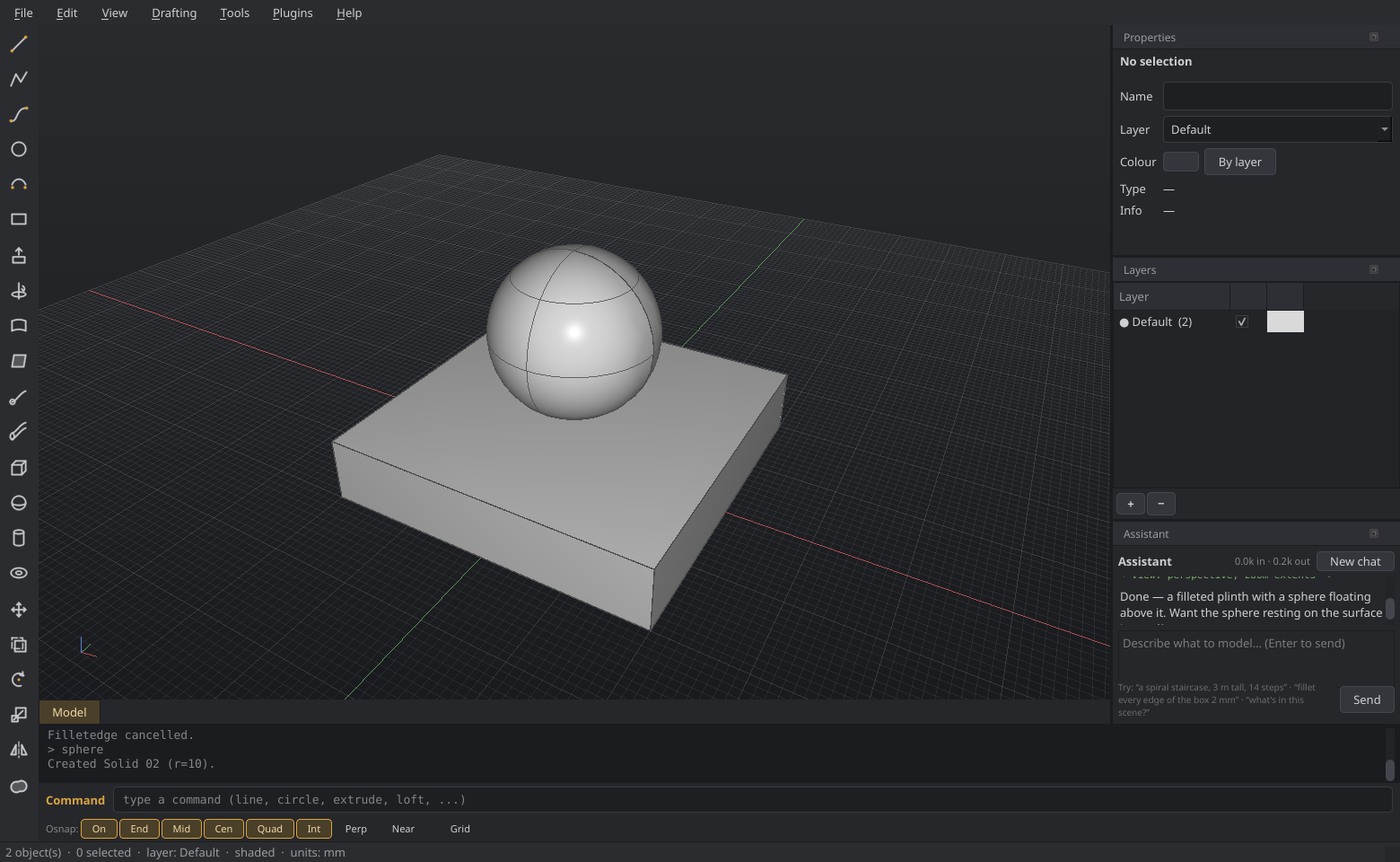
Prefer to stay inside the app? View → Assistant (or type ai) opens a chat
panel that builds real geometry in your live scene — it uses the same command
surface and can look at the viewport to check its own work. It needs an
Anthropic API key (Settings → Assistant); the key never leaves your machine
except to call the API.
The bridge
The running GUI opens a localhost-only JSON-RPC socket
(~/.serpentine3d/rpc.port); the MCP server (serp3d-mcp) connects to it. Set
SERP3D_NO_RPC=1 to disable it.